Friday, April 3, 2020

Coronavirus confirmed as pandemic by World Health Organization
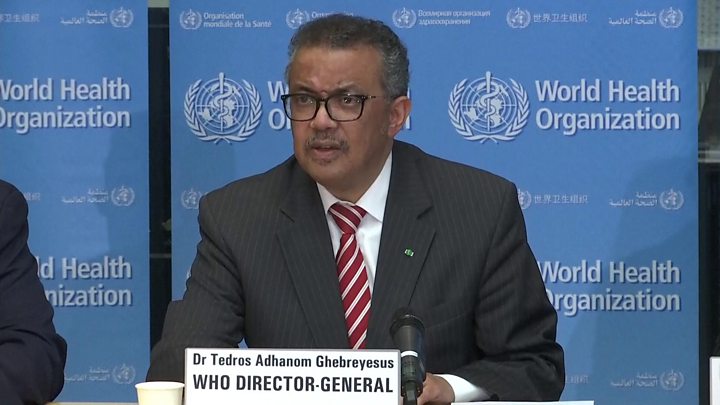
Media captionCoronavirus outbreak has officially become pandemic says WHO
The coronavirus outbreak has been labelled a pandemic by the World Health Organization (WHO).
WHO chief Dr Tedros Adhanom Ghebreyesus said the number of cases outside China had increased 13-fold in two weeks. He said he was "deeply concerned" by "alarming levels of inaction".
A pandemic is a disease that is spreading in multiple countries around the world at the same time.
Hours later Italy said all shops except food shops and pharmacies would close.
Announcing the toughest lockdown seen yet in Europe, Prime Minister Giuseppe Conte said bars, hairdressers, restaurants and cafes that could not guarantee a metre's distance between customers and non-essential company departments would also close.
The impact of the tightened restrictions - in force from Thursday until 25 March - on the rate of new coronavirus cases would take a couple of weeks to be seen, Mr Conte said.

What did the WHO say?

Dr Tedros said that calling the outbreak a pandemic did not mean the WHO was changing its advice about what countries should do.
He called on governments to change the course of the outbreak by taking "urgent and aggressive action".
"Several countries have demonstrated that this virus can be suppressed and controlled," he said.
"The challenge for many countries who are now dealing with large clusters or community transmission is not whether they can do the same - it's whether they will."
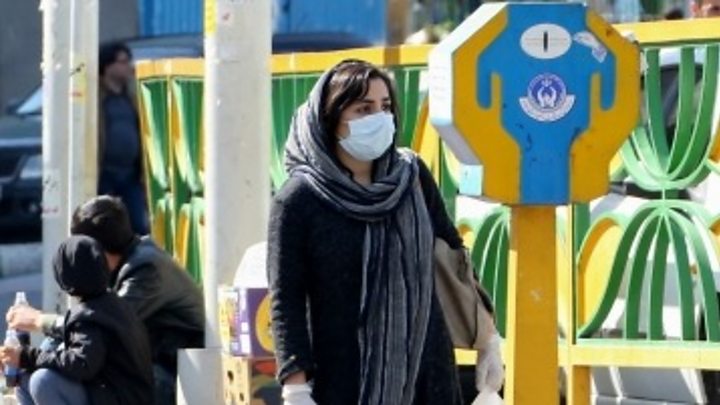
Media captionA video circulating in Iran shows a morgue in the city of Qom, full of dead bodies
Governments had to "strike a fine balance between protecting health, minimising disruption and respecting human rights".
"We're in this together to do the right things with calm and protect the citizens of the world. It's doable," he said.
His appeal was followed by the several other countries announcing ever more stringent restrictions to try to prevent the virus taking a hold.
Denmark - which has 514 confirmed cases, up 10-fold since Monday, but no deaths so far - is to close all schools and universities from Friday and will send home all public sector employees who are not in critical roles in the coming days. The government also urged the cancellation of events with more than 100 people attending.
Meanwhile India has suspended most visas for foreigners until 15 April and Guatemala is banning European citizens from entering from Thursday.

What is the situation in Italy and Iran?

The country has already closed schools, gyms, museums, nightclubs and other venues across the country.
It has more than 12,000 confirmed cases and a death toll of 827. Nearly 900 people with the virus in Italy were in intensive care, the WHO's emergencies head Michael Ryan said.
Dr Ryan said the situation in Iran - where the official figures are 354 deaths among 9,000 cases - was "very serious". The WHO had sent 40,000 testing kits to Iran but there was still a shortage of ventilators and oxygen.
"Iran and Italy are suffering now but I guarantee you other countries will be in that situation very soon," he said.
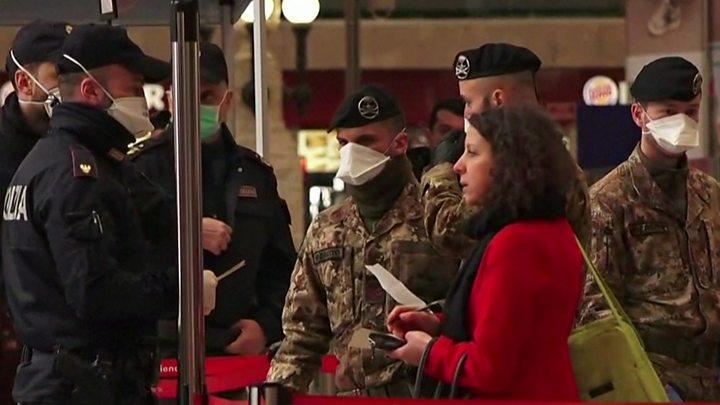
Media captionWhat life looks like under Italy's coronavirus lockdown
Earlier, Germany's Chancellor Angela Merkel warned that up to 70% of the country's population - some 58 million people - could contract the coronavirus. She said since there was no known cure, the focus would fall on slowing the spread of the virus. "It's about winning time," she said.
Some German virologists dispute the high figure. Former federal government adviser on disease control, Prof Alexander Kekulé, told German media he saw a worst case scenario of 40,000 cases.
The number of confirmed cases in Germany has risen to 1,567 from 1,296, the Koch institute for infectious diseases said.

Presentational grey line

Why is it being called a pandemic now?

By Philippa Roxby, BBC Health
The use of the p-word by the WHO to describe the global spread of this new coronavirus is not a huge surprise.
Up until now, it has talked merely of the "threat" or the "potential" for a pandemic. But with cases in more than 100 countries, and increasing numbers not linked to travel, the language has changed.
The WHO no longer 'declares' a pandemic the way it used to, so this is as official as it gets. Yet this doesn't mean the pandemic cannot be controlled, it explains.
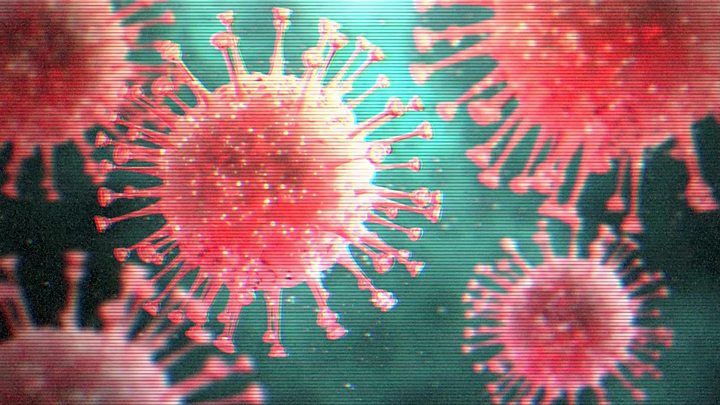
Media captionEpidemic v pandemic: What's the difference?
It's a call to action and a plea for all countries not to give up, no matter how large the number of cases.
Practically, countries are being told to continue to do what they have been advised to do. That means some may have to step up their response.
But the WHO is not changing what it's doing or the threat level of the virus.
What the use of the word "pandemic" highlights is the importance of countries around the world taking urgent action to respond to their own outbreaks - because now it's everyone's responsibility to turn the tide on the virus.

Banner image reading 'more about coronavirus'
Banner

What else is happening?

France said there had been 48 deaths in the country, an increase of 15 from Tuesday. There are 2,281 confirmed cases. Coronavirus-linked restrictions have been extended to two more areas, France's health minister said.
In the western US, Washington state is banning some large gatherings in certain areas and has told all school districts to prepare for possible closures in the coming days. The governor of Seattle's King County said he expected a serious coronavirus outbreak within weeks.
In the eastern US, New York's governor announced that troops would be sent into New Rochelle, in an attempt to contain an outbreak of the virus, as the total number of US cases passed 1,000 on Wednesday.
A one-mile (1.6km) containment zone was in force around the town north of Manhattan. Some individuals have been quarantined.
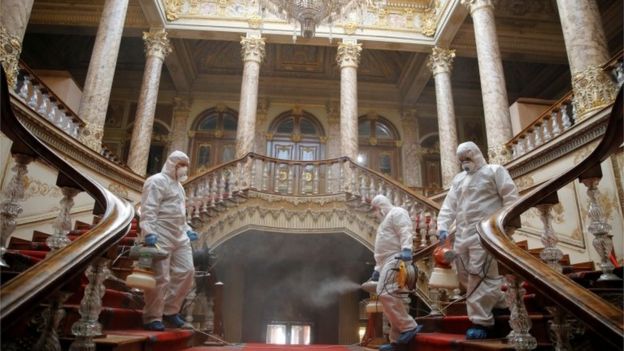
workers disinfect Dolmabahce Palace in IstanbulImage copyrightREUTERS
Image captionWorkers disinfect Dolmabahce Palace in Istanbul
Music festivals and other major events in the US, including Coachella festival in California, have been cancelled or postponed. The E3 gaming show set for Los Angeles in June is among those cancelled.
Thousands of flights have been cancelled worldwide as airlines struggle to cope with a slump in demand.
A UK health minister, Nadine Dorries, said she had tested positive for coronavirus and was self-isolating at home.
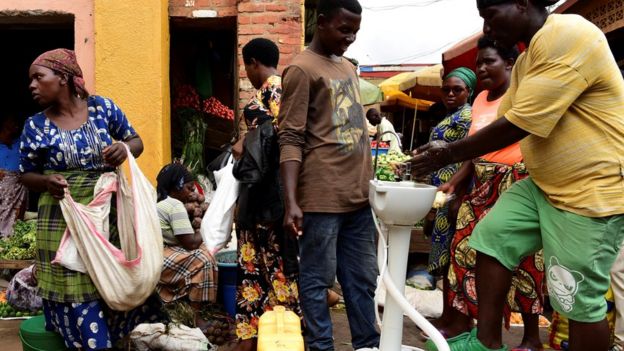
public handwashing station at a bus station in KigaliImage copyrightREUTERS
Image captionRwanda has asked citizens to wash their hands before boarding buses at this bus station in the capital Kigali
Several countries - including Sweden and Bulgaria, as well as the Republic of Ireland - have recorded their first deaths, while the number of confirmed cases in Qatar jumped from 24 to 262.
China - where the virus was first detected - has seen a total of 80,754 confirmed cases and 3,136 deaths. But it recorded its lowest number of new infections, just 19, on Tuesday.
Interesting facts about world

With around 200 countries and more than 7.5 billion people, the world is full of interesting, fun, and fascinating people, places, and things. In the land of the Kiwis, for instance, you'll find the highest concentration of pet owners on the planet. And over in Nicaragua, you'll find one of the only two flags in the world that features the color purple. Hungry for more facts about the world and its ever-growing population? Read on to learn some interesting facts about the Earth's past, present, and future.

1
North Korea and Cuba are the only places you can't buy Coca-Cola.

Phnom Penh, Cambodia- January 02, 2014. Coca-Cola and Pepsi bottles stacked in plastic container - vintage style. Symbolic representation of one of the greatest business rivalries of all time. - Image
Shutterstock
No matter where you go, it's comforting to know you can always enjoy a Coca-Cola. Well, almost anywhere. While this fizzy drink is sold practically everywhere, it still hasn't (officially) made its way to North Korea or Cuba, according to the BBC. That's because these countries are under long-term U.S. trade embargoes.
However, some folks say you might be able to snag a sip of the stuff if you try hard enough (although it'll typically be a lot more expensive than what you would pay in the states—and probably imported from a neighboring country such as Mexico or China).

2
The entire world's population could fit inside Los Angeles.

the sunset strip in hollywood california, the sunset boulevard in los angeles, most common street names
Shutterstock
The world's total population is more than 7.5 billion. And obviously, that number sounds huge. However, it might feel a little more manageable once you learn that if every single one of those people stood shoulder-to-shoulder, they could all fit within the 500 square miles of Los Angeles, according to National Geographic.

3
There are more twins now than ever before.

twin children
Shutterstock
You might think twins are a rarity, but they're actually becoming more common than ever. "From about 1915, when the statistical record begins, until 1980, about one in every 50 babies born was a twin, a rate of 2 percent," writes Alexis C. Madrigal of The Atlantic. "Then, the rate began to increase: by 1995, it was 2.5 percent. The rate surpassed 3 percent in 2001 and hit 3.3 percent in 2010. [That means] one out of every 30 babies born is a twin."
Scientists believe this trend is due to the fact that older women tend to have more twins, and women are choosing to start families later. Fertility treatments such as in-vitro fertilization likely also play a role.

4
The hottest chili pepper in the world is so hot it could kill you.

Dragon's breath chili peppers
Shutterstock
The "weapons-grade" Dragon's Breath chili pepper is so hot it's downright deadly. If you ate one, it could potentially cause a type of anaphylactic shock, burning the airways and closing them up.
"I've tried it on the tip of my tongue and it just burned and burned," said Mike Smith, the hobby grower who invented the Dragon's Breath along with scientists from Nottingham University. So why make such an impractical pepper? As it turns out, the chili was initially developed to be used in medical treatment as an anesthetic that can numb the skin.

5
More people visit France than any other country.

learn a new language
Shutterstock
France is a beautiful country, filled to the brim with delicious wines, scrumptious cheese, and tons of romance. So it's no surprise that more people want to visit France than any other country in the world, according to the United Nations World Tourism Organization.
In 2017, the European country welcomed 86.9 million people. Spain was the second-most popular destination with 81.8 million visitors, followed by the United States (76.9 million), China (60.7 million), and Italy (58.3 million). La vie est belle!

6
The world's most densely populated island is the size of two soccer fields.

santa cruz island
Unsplash/ Sid Verma
Santa Cruz del Islote in the Archipelago of San Bernardo off the coast of Colombia may only be about the size of two soccer fields (AKA two acres), but the artificial island has four main streets and 10 neighborhoods. Five hundred people live on the island in around 155 houses. With so many people packed into such a small space, it's the most densely populated island in the world, according to The Guardian.

7
The Canary Islands are named after dogs, not birds.

cocker spaniel - dog puns
Shutterstock
It might seem safe to assume that the Canary Islands were named after canary birds, but the location was actually named after dogs. Although it's off the coast of northwestern Africa, the archipelago is actually part of Spain. In Spanish, the area's name is Islas Canarias, which comes from the Latin phrase Canariae Insulae for "island of dogs." World facts related to dogs? Now those we can get behind!

8
Indonesia is home to some of the shortest people in the world.

Bolivia tourists National Geographic bee questions
Shutterstock
Though there are short people and tall people everywhere, Indonesia is home to some of the shortest people in the world, according to data compiled from various global sources by the Telegraph in 2017.
When taking both genders into account, the average adult is around 5 feet, 1.8 inches. People in Bolivia don't tend to be much taller, with an average adult height of 5 feet, 2.4 inches. The tallest people among us live in the Netherlands, where the average adult height is 6 feet.

9
The Paris Agreement on climate change was signed by the largest number of countries ever in one day.

flags outside of the united nations building in geneva switzerland
Shutterstock
When 174 world leaders signed the Paris Agreement on Earth Day in 2016 at the United Nations (UN) headquarters in New York, it was the largest number of countries ever to come together to sign anything on a single day, according to the UN. The agreement aimed to combat climate change and accelerate and intensify the actions and investments needed to strengthen the global climate effort.

10
The world's quietest room is located at Microsoft's headquarters in Washington state.

microsoft logo
Shutterstock
Silence is golden, as they say. And while it may not be worth quite as much as jewels and gold to most people, it certainly was the primary goal for those who built the quietest room in the world. Located at Microsoft's headquarters in Redmond, Washington, the lab room measures a background noise of -20.35 dBA, which is 20 decibels below the threshold of human hearing and breaks previous records for spaces that were deemed the planet's quietest places, according to CNN.
"As soon as one enters the room, one immediately feels a strange and unique sensation which is hard to describe," Hundraj Gopal, a speech and hearing scientist and principal designer of the anechoic chamber at Microsoft, told CNN. "Most people find the absence of sound deafening, feel a sense of fullness in the ears, or some ringing. Very faint sounds become clearly audible because the ambient noise is exceptionally low. When you turn your head, you can hear that motion. You can hear yourself breathing and it sounds somewhat loud."

11
There are only three countries in the world that don't use the metric system.

meter ruler for metric system, 1970s nostalgia
Shutterstock
For simplicity's sake, most of the more than 200 countries in the world use the metric system when describing things like length or mass. However, there are three countries that stand out: Liberia, Myanmar, and the United States.
And soon, that number might be down to two. In 2018, Liberia commerce and industry minister Wilson Tarpeh said the government plans to adopt the metric system in order to promote accountability and transparency in trade, according to the Liberian Observer.

12
The longest place name on the planet is 85 letters long.

EMJ83G Taumatawhakatangihangakoauauotamateaturipukakapikimaungahoronukupokaiwhenuakitanatahu longest place name in New Zealand
Alamy
People who live in Mamungkukumpurangkuntjunya Hill, Australia, need a little patience when it comes to learning to spell their hometown's name. But you know what? So do the folks from Lake Chargoggagoggman-chauggagoggchaubunagungamaugg in Massachusetts and Tweebuffelsmeteen-skootmorsdoodgeskietfontein, South Africa.
None of them have quite as much work to do when jotting down their address as those who live in Taumatawhakatangihanga-koauauotamateaturipukakapikimaung-ahoronukupokaiwhenuakitanatahu, New Zealand, though. At 85 letters long, this is the longest place name in the world.

13
Four babies are born every second.

parents kissing baby, how parenting has changed
Shutterstock
Every second, we welcome four new babies into our overall population. Do a little math and you'll find out that means there are approximately 250 births each minute, 15,000 each hour, and 360,000 each day. In a full year, there are around 131.4 million babies born on Earth, according to the Ecology Global Network.

14
The coldest temperature ever recorded was -144 degrees Fahrenheit.

snow in rome
Shutterstock
You might think you're accustomed to frigid air and blustery winds, but the average winter day has nothing on the coldest day ever recorded, which was -144 degrees Fahrenheit. The temperature was recorded in Antarctica during a span of research between 2004 and 2016. Just a few breaths of air at that temperature would induce hemorrhaging in your lungs and kill you.

15
The Earth's ozone layer will make a full recovery in 50 years.

things to be thankful for in 2018
Shutterstock
Because of pollution, the Earth's ozone layer has suffered a lot. That's bad news for everyone, since the fragile gas layer protects our planet and shields us from the sun's harmful ultraviolet rays. Fortunately, climate change experts believe that the ozone layer will fully heal within 50 years, according to a 2018 report from the United Nations.
The recovery is thanks in large part to the Montreal Protocol of 1987, which put a global ban on the use of one of the main culprits for the damage: chlorofluorocarbons (CFOs). Previously, CFOs had been common in refrigerators, aerosol cans, and dry-cleaning chemicals.

16
Japan is the world's most earthquake-prone country.

earthquake country
Shutterstock
Earthquakes can range from minor tremors that are barely noticeable to building-toppling ground-shakers that cause massive destruction. But it's an inevitable part of life for those who live in countries such as China, Indonesia, Iran, and Turkey, which are some of the most earthquake-prone places on the planet. However, according to the U.S. Geological Survey, Japan records the most earthquakes in the world.

17
There are around 4 quadrillion quadrillion bacteria on Earth.

Bacteria Astonishing Facts
Shutterstock
Not all bacteria are bad. In fact, some of those itty-bitty biological cells are actually good for us and aide the world in various and complex ways. And that's nice to know, considering there are around 4 quadrillion quadrillion individual bacteria on our planet, according to NPR.

18
People who are currently alive represent about 7 percent of the total number of people who have ever lived.

People Walking in Crowded City Life in 100 Years
Shutterstock
Here's another world fact to keep in the back of your mind: According to the Population Reference Bureau, since the time Homo sapiens first hit the scene 50,000 years ago, more than 108 billion members of our species have been born. And a large chunk of that number is alive right now. According to the bureau, the number of people alive today represents a whopping seven percent of the total number of humans who have ever lived.

19
Muhammad is thought to be the most popular name in the world.

crazy facts
Shutterstock
Step aside John, James, Mary, and Jane—the most popular name in the world is believed to be Muhammad. According to the Independent, an estimated 150 million men and boys around the world share this name. The popularity is thanks to a Muslim tradition of naming each first-born son after the Islamic prophet.

20
Only two countries use purple in their national flags.

dominca flag, astonishing facts
Shutterstock
Looking for some more interesting facts? Well, here's one: The flag of Nicaragua features a rainbow in the center that includes a band of purple, while the flag of Dominica boasts a picture of a sisserou parrot, a bird with purple feathers. These elements make them the only two flags in the world that use the color purple.
